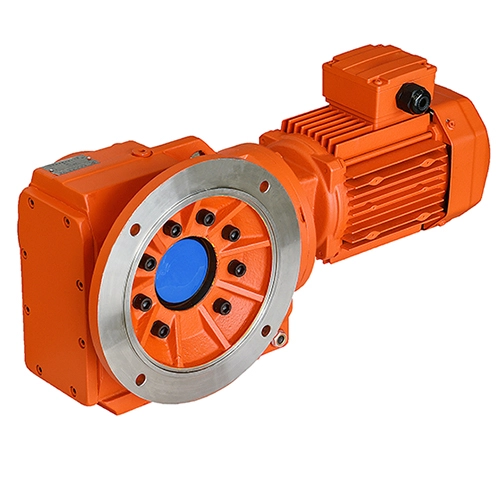
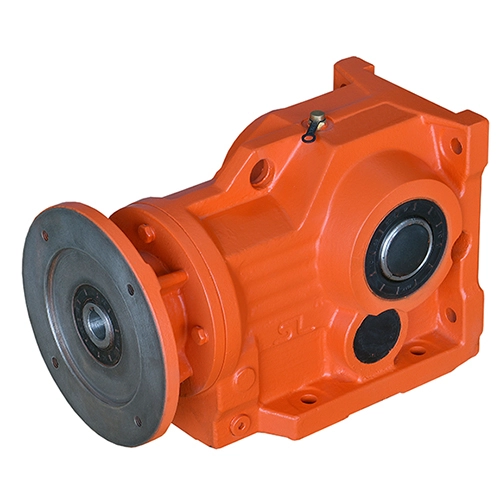
Bevel Helical Geared Motor – KC Helical-Bevel Gearmotor

KC Helical-Bevel Gearmotor Sizing Hub

KC Helical-Bevel Gearmotor Sizing Hub

Use this hub to specify a bevel helical geared motor for a right-angle drive layout, and to judge when inline helical geared motors are the simpler answer for conveyors, packaging machines and general automation. Work through the selection inputs, the KC37 to KC187 frame range, the mounting options and the trade-off matrix, then send your duty data for a quotation.

  • Layout options Inline helical or right-angle bevel helical
  • Frame sizes KC37 through KC187
  • Sizing inputs Torque, speed, duty cycle, mounting
KC series helical-bevel geared motor

Selection logic

Inline Helical or Right-Angle Bevel Helical?

Both layouts reduce motor speed to a usable output speed. The decision is made by where the motor can physically sit, how much torque has to fit inside the frame, and how the unit is fixed to the machine.

Inline helical drive

  • Motor and gearbox share one axis, so alignment and coupling work stay simple.
  • Fewer right-angle stages, which keeps transmission losses low on long, straight machine frames.
  • Best when the frame can accept extra length and the driven shaft sits on the machine centre line.
  • Compare the RC series helical geared motor and the FC series parallel shaft helical geared motor in the series table further down.

Right-angle bevel helical drive (KC series)

  • The KC series combines helical gears with spiral bevel gears, so the output turns 90° to the input and the unit stays compact.
  • Large transmission torque with steady running, plus low vibration and low noise.
  • Transmission efficiency is much higher than the SC series.
  • Fits conveyor drive heads, automated packaging systems and stage machinery where the motor must sit alongside the shaft.
Decision factor Inline helical Right-angle bevel helical
Drive direction Input and output sit on the same axis line. Input turns 90° to the output, so the motor sits beside the driven shaft.
Space envelope Longer along the shaft axis, low in profile. Short axially, but needs side clearance for the motor.
Torque density Grows with frame size and additional stages. High torque in a compact housing by combining helical and spiral bevel stages.
Mounting Foot or flange on a flat machine frame. Horizontal or vertical, with flange, torque arm or threaded-hole fixing.
Typical applications Straight in-line drives in general machinery. Metallurgy, petrochemical, mining, packaging, conveyors, ceramic, printing and stage machinery.

Data intake

Selection Input Checklist

Collect these eight items before comparing frame sizes. A quotation that is missing any of them usually comes back as a question instead of a confirmed model.

1. Load torque at the output

Record the continuous and peak torque the machine actually needs at the driven shaft, not at the motor, including start-up and jam conditions.

2. Required output speed

Write down the output rpm the process needs, then check it falls inside the KC output speed range of 0.15–270 rpm.

3. Service factor

Apply a service factor that reflects the shock level of the driven machine before you compare your load torque with any permitted torque figure.

4. Duty cycle

Continuous, intermittent or reversing duty changes heat build-up and lubrication expectations, so describe the daily running pattern.

5. Starts per hour

Frequent starts raise thermal and inertial load on both gear unit and motor. Count the worst hour of the working day.

6. Radial and axial loads

List belt, chain, sprocket or coupling loads acting on the output shaft, together with their distance from the housing.

7. Ambient conditions

Temperature, dust, humidity and wash-down practice influence sealing, coating and oil choices for the unit.

8. Mounting and input form

Decide whether the unit hangs from a flange, a torque arm or threaded holes, and whether the input is motor-connected, flange input or shaft input.

Product data

KC Series Spec Envelope and Model Range

The KC series helical-bevel geared motor covers twelve frame sizes, from KC37 to KC187, so you can match the housing to the available space instead of oversizing the drive.

KC series helical-bevel geared motor,SL-Transmission China geared motor,20CrMnTi Alloy KC Series - Helical Geared Motor Manufacturer
KC series helical-bevel geared motor, combining helical and spiral bevel gearing in one housing.
Model range KC37 ~ KC187 Twelve frame sizes
Output speed 0.15 ~ 270 rpm Across the series
Output torque Up to 50,000 Nm Top of range KC187
Motor power 0.18 ~ 200 kW Directly connected, flange or shaft input
Installation Horizontal or vertical Bottom threaded hole, case end face threaded hole, small flange, torque arm
Construction 20CrMnTi alloy steel Ground gears at grade 6~5

Permitted torque is the ceiling for a frame size, not a target. Apply your service factor to the load torque first, then use the shaft diameter and center height below to check the output connection.

Model Shaft dia. (mm) Center height (mm) Motor power (kW) Ratio Permitted torque (Nm) Weight (kg)
KC37 25k6 30 0.12 ~ 2.2 8 ~ 102 180 13
KC47 35k6 35 0.18 ~ 4 8 ~ 126 380 22
KC57 35k6 40 0.25 ~ 5.5 8 ~ 143 580 29
KC67 40k6 40 0.37 ~ 7.5 8 ~ 143 680 33
KC77 50k6 50 0.75 ~ 11 8 ~ 175 1300 45
KC87 60m6 60 1.5 ~ 18.5 8 ~ 197 2500 81
KC97 70m6 70 2.2 ~ 30 8 ~ 197 3900 150
KC107 90m6 90 4 ~ 45 8 ~ 197 6800 230
KC127 100m6 100 7.5 ~ 90 8 ~ 197 11200 420
KC157 120m6 120 11 ~ 110 8 ~ 198 11700 680
KC167 160m6 135 15 ~ 160 18 ~ 186 32000 1050
KC187 190m6 155 18.5 ~ 200 18 ~ 186 50000 1650

Weights are quoted without oil and without the motor; shaft and flange input versions add 10%.

Trade-offs

Inline vs Bevel Helical Trade-Off Matrix

Read the matrix row by row and decide which two rows matter most on your machine. The layout that wins those two rows is normally the correct purchase.

Aspect Inline helical Right-angle bevel helical What it means for your machine
Space envelope Long along the drive axis, low profile Short axially, motor sits 90° to the output Choose right-angle when machine length is fixed but side space exists.
Torque density Rises with frame size and extra stages High: helical plus spiral bevel stages in a compact housing Right-angle pays off where high torque must fit a small frame.
Transmission efficiency Typically the highest, with the fewest right-angle stages Very high, with one bevel pair added; stated as much higher than the SC series On continuous high-power duty, weigh energy cost against the layout benefit.
Ratio coverage Wide ratio range in a single unit Ratio from 8~102 on KC37 up to 18~186 on KC187 Confirm the exact ratio at the frame size you select, not just the series range.
Mounting flexibility Foot or flange on a flat frame Horizontal or vertical, bottom threaded hole, case end face threaded hole, small flange or torque arm More mounting choices mean fewer custom brackets and faster installation.
Noise and vibration Smooth running; depends on stage count Precision-ground gears at grade 6~5 keep noise and vibration low Decisive near operators, in packaging halls and on stage machinery.
Initial cost Lower for the same torque where space allows Higher, because of the extra bevel stage Right-angle is chosen for layout reasons, not for the lowest first cost.
Maintenance Oil level and general inspection Oil level, inspection and seal checks at the output end Plan a service window for both; right-angle units are easier to reach when the motor is remote.

Sizing tool

Shortlist a KC Frame Size

Start from the load torque you calculated with your service factor, find the matching band, then confirm the ratio delivers the output speed you need.

KC series helical-bevel speed reducer for frame size shortlisting
The same right-angle housing family scales from KC37 to KC187, so your first shortlist is a frame-size decision.
Required torque (with service factor) Candidate frames Confirm next
Up to 180 Nm KC37 Shaft 25k6 with 30 mm center height; ratio 8~102
181 ~ 680 Nm KC47, KC57, KC67 Motor power 0.18~7.5 kW; ratio 8~143
681 ~ 3,900 Nm KC77, KC87, KC97 Motor power 0.75~30 kW; ratio 8~197
3,901 ~ 11,200 Nm KC107, KC127 Motor power 4~90 kW; shaft 90m6 / 100m6
11,201 ~ 32,000 Nm KC157, KC167 Motor power 11~160 kW; ratio 8~198 or 18~186
Above 32,000 Nm KC187 Motor power 18.5~200 kW; ratio 18~186; 1,650 kg

This is a first shortlist, not a final selection. The same frame covers a whole ratio band, so output speed, mounting and shaft connection still have to be checked before ordering. If your layout does not need a 90° turn, compare the inline RC and FC series in the series table below.Build quality

Material and Reliability Proof Stack

Reliability on a geared drive comes from three things: the steel, the heat treatment and how accurately the teeth are finished. Here is what the KC series documents.

20CrMnTi alloy steel

Gears are made from 20CrMnTi alloy steel, giving the core strength and case hardness needed for heavy-duty industrial duty.

HRC58~62 hardness

Tempering, cementing and quenching raise gear hardness to HRC58°~62° before final finishing.

Grade 6~5 ground gears

All gears are accurately ground, with precision reaching grade 6~5 for accurate, quiet meshing.

Low noise and vibration

Precision grinding keeps vibration and noise low, which protects nearby equipment and improves the working environment.

Heat treatment and testing

Gearboxes go through rigorous heat treatment and testing before dispatch, so a unit leaves the plant as a checked assembly.

Higher efficiency than SC series

The combined helical and bevel design delivers transmission efficiency much higher than the SC series, supporting energy savings and lower running cost.

Buyer decision: ask for the material, hardness and gear accuracy grade for the exact frame size you order, and keep the oil and inspection intervals aligned with your duty cycle.

Application fit

Scenario-to-Specification Decisions

Different applications make different inputs dominant. Match your scenario below, then lock that input into the checklist before you compare frames.

Application scenario What usually decides the size Specify or confirm
Belt and chain conveyors Starting torque and starts per hour Load torque with service factor, output speed, torque arm or flange mounting
Automated packaging systems Compact footprint and smooth motion Right-angle layout, ratio band, output connection, noise expectation
Metallurgical machinery Heat, dust and near-continuous running Ambient temperature, duty cycle, lubrication and inspection interval
Petrochemical machinery Round-the-clock operation Duty cycle, oil change schedule, mounting position, coupling loads
Mining and construction machinery Shock loads and rough handling Service factor, radial and axial loads, protected mounting and sealing
Printing and packaging machinery Even motion at low output speed Output speed inside 0.15–270 rpm, ratio, gear accuracy grade 6~5
Ceramic machinery Abrasive dust around the drive Sealing arrangement, ambient conditions, vertical or horizontal mounting
Stage machinery Quiet operation and repeatable positioning Low vibration and noise, ratio accuracy, vertical mounting

Request a KC Series Quotation

Send the sizing data for your machine and the engineering team will propose a frame size, ratio, mounting and input form for the KC series helical-bevel geared motor. Quotes can cover a single replacement unit or a volume order for an OEM build, and a model datasheet can be issued alongside the offer.

  • Required output torque, with your service factor applied
  • Required output speed or the ratio you have in mind
  • Motor power or the motor you plan to mount
  • Mounting position and preferred input form
  • Duty cycle and starts per hour
  • Ambient conditions, and quantity if you are ordering in volume

Related Reading

Three notes to help clarify product requirements before contacting the supplier.

How to Choose a Helical Gear Motor Manufacturer for Conveyor Drives

Choosing the right helical geared motor supplier for a conveyor project comes down to three practical questions: will the drive fit the real duty, can the factory repeat the same quality across…

Read article

KC Series Helical Bevel Gear Motor Sizes for Conveyor Drives

Conveyor engineers can narrow KC37 to KC187 helical bevel gearmotor sizes by matching line speed, torque, ratio, shaft, and mounting data before drawing review.

Read article

Hollow Shaft Helical Bevel Geared Motors for Packaging Lines

A packaging line drive fits when the hollow shaft bore, mounting style, and radial load support match the machine frame and driven shaft.

Read article

Frequently Asked Questions

what is the difference between a bevel helical geared motor and an inline helical geared motor?

a right-angle bevel helical unit such as the kc series combines helical gears with spiral bevel gears, so the output turns 90° to the input and the housing stays compact. an inline or parallel shaft helical unit keeps input and output on the same axis, which suits long, straight machine frames.

what is the kc series model range and output capability?

the range runs from kc37 to kc187, with output speed from 0.15 to 270 rpm, output torque up to 50,000 nm and motor power from 0.18 to 200 kw. input forms are directly connected with motor, flange input or shaft input.

how do i shortlist a kc model from my application data?

start with the load torque at the driven shaft, multiply it by a service factor that matches the shock level of the machine, then compare the result with the permitted torque of each frame size. confirm the ratio delivers your required output speed, and check the shaft diameter and center height against the driven connection.

which mounting and installation forms are available?

the kc series supports horizontal and vertical installation, with horizontal type bottom threaded hole fixing, case end face threaded hole fixing, small flange installation and torque arm installation. choose the form that matches how the unit is supported on your machine frame.

what are the gears made of, and how accurate are they?

gears are made from 20crmnti alloy steel, hardened to hrc58°~62° through tempering, cementing and quenching, then accurately ground to a precision of grade 6~5. that combination keeps vibration and noise low during operation.

how do i request a quotation or a model datasheet?

send your output torque with service factor, output speed or ratio, motor power, mounting position, input form, duty cycle, ambient conditions and quantity. weights are quoted without oil and without the motor, and shaft or flange input versions add 10%. include these details and the reply can come back as a confirmed frame size rather than a general price.

CONTACT US

If you have any queries, get in touch today! Don't hesitate. We try to take the extra step for our customer satisfaction.
Name
Email *
Whatsapp/Wechat
Message
Verification Code *
Verification Code
Leave a message
Name
Email *
Whatsapp/Wechat
Message
Verification Code *
Verification Code